
As an Amazon Associate, we earn from qualifying purchases. This post contains affiliate links – if you buy through them, we may earn a commission at no extra cost to you.
Finding the best green coffee beans depends on your taste and roasting setup. Smokin Beans Ethiopia Yirgacheffe offers a classic washed cup with lemon and black tea notes. Ethiopian Guji Natural delivers thick, berry-heavy sweetness from a dry process.
1. Smokin Beans Ethiopia Yirgacheffe

Best for: roasters who want crisp citrus and clean floral tea flavors.
Grown at 2,100 meters in the Gedeo Zone, this coffee comes from native rainforest shade. High-altitude heirloom seeds are dense, requiring careful temperature control. Washed processing leaves the bean surface clean, reducing chaff. It yields a cup defined by Meyer lemon, floral notes, orange, and dark caramelized sugar with medium-high acidity.
Good if:
- You enjoy crisp lemon, black tea, and floral notes.
- You roast on equipment that handles dense, high-elevation seeds well.
- You prefer washed beans that produce minimal chaff mess.
Skip it if:
- You prefer low-acid, chocolate-heavy profiles.
- You lack the storage space for a large 5-pound bag.
2. Roastika – Ethiopia Yirgacheffe – Premium Green Coffee Bean

Best for: small-batch home roasters seeking floral jasmine and gentle acidity.
Roastika offers washed Arabica beans grown between 1,700 and 2,000 meters, packaged in a manageable 2-pound quantity. The seller notes an 86 cupping score and 10.6% moisture content to help predict the drying phase. These beans produce delicate flavors of red berries, jasmine, and black tea alongside a smooth, medium body. A light roast protects these subtle aromatics.
Good if:
- You want an exact 2-pound bag for small testing batches.
- You like delicate jasmine aroma and red berry notes.
- You prefer an official cupping score to gauge bean quality.
Skip it if:
- You want heavy, syrupy body in your morning mug.
- You want a large volume for continuous daily drinking.
3. Kenya Ironman Estate AA – Green Unroasted Coffee 1LB

Best for: coffee fans wanting bold tropical fruit and jammy sweetness.
Kenya Ironman Estate AA stands out because it uses natural processing rather than the traditional washed method typical of high-grade Kenyan lots. Natural drying allows fruit sugars to seep into the seed for a heavier body and tropical fruit complexity.
Natural coffees create more chaff than washed beans. That extra sugar on the bean surface also caramelizes quickly, requiring you to drop your charge temperature to avoid surface scorching before first crack finishes.
Good if:
- You want juicy berry notes paired with syrupy sweetness.
- You appreciate the consistent bean size of an AA grade.
- You enjoy sweet, fruit-forward natural processing.
Skip it if:
- You dislike cleaning heavy chaff out of your roaster collector.
- You want a sharp, savory, traditional washed Kenyan cup.
4. Ethiopian Guji Natural

Best for: drinkers who crave intense strawberry, peach, and blueberry sweetness.
Sourced from Ethiopia’s high-altitude Guji Zone between 1,800 and 2,200 meters, this naturally processed heirloom coffee is built for vibrant fruit extraction. Sun-drying on raised beds translates into strawberry, blueberry, and tropical fruit notes. The Strictly High Grown classification produces dense seeds that handle heat well for complex fruit flavors.
Natural heirloom lots have slight bean size variations. Roasting them too fast can cause the outer sugars to brown before the dense core finishes expanding, leading to grassy undertones if you pull the roast too early.
Good if:
- You love wild blueberry and strawberry aromatics.
- You want high-elevation, dense beans that handle heat well.
- You prefer buying 5-pound bags for long-term use.
Skip it if:
- You prefer simple chocolate and roasted nut flavor notes.
- You roast on low-power air poppers that struggle with dense beans.
5. Smokin Beans Rwanda AA Kopakaki

Best for: pour-over lovers looking for cranberry brightness and black tea.
This AA-grade Arabica coffee comes from the Kopakaki cooperative near Lake Kivu, grown at 1,700 meters above sea level in nutrient-rich volcanic soil. It consists of the Red Bourbon variety, sun-dried on raised beds following a clean washing process. The listing highlights delicate tasting nuances of cranberry, lemonade, peach, and black tea with medium-high sweetness. These qualities shine brightest when roasted light, ideal for pour-overs.
Red Bourbon beans react quickly to heat adjustments, so you must carefully regulate airflow to avoid stalling your roast after first crack. The harvest window is April to June.
Good if:
- You brew daily with manual pour-over drippers.
- You enjoy crisp cranberry and citrus fruit flavors.
- You want single-origin Red Bourbon Arabica.
Skip it if:
- You dislike sharp, tart fruit acidity in brewed coffee.
- You roast exclusively for dark espresso extractions.
6. Tesoros Del Pais Green Unroasted Coffee Beans Ahuachapan

Best for: roasters seeking gentle citrus sweetness with low chaff cleanup.
Grown on a single estate in Ahuachapan at elevations between 4,500 and 5,000 feet, this coffee features honey processing. The producer leaves fruit mucilage on the bean, giving it an orange tint. This natural sugar layer increases sweetness and rounds out acidity compared to standard washed coffees.
The dried mucilage browns earlier in the roast cycle than clean washed parchment. Rely on bean temperature and acoustic cracks rather than surface color to avoid premature roasting.
Good if:
- You want the protective storage benefits of Ecotact packaging.
- You like honey-processed sweetness with balanced acidity.
- You prefer single-estate sourcing from El Salvador.
Skip it if:
- You judge roast development entirely by surface color.
- You want pungent, fruit-bomb berry aromatics.
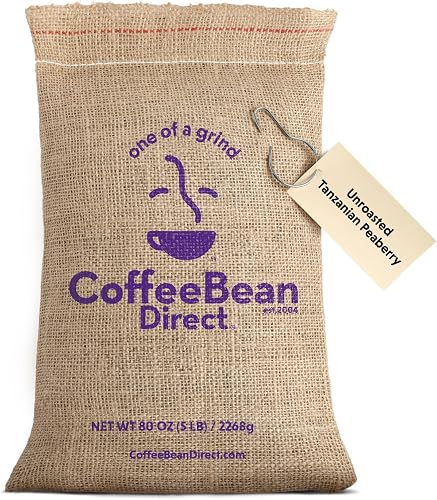
7. Coffee Bean Direct Unroasted Tanzanian Peaberry
Best for: light-roast fans who want winey fruit and smooth chocolate.
Tanzanian Peaberries are single round seeds rather than the usual twin flat beans. Their shape promotes uniform heat distribution across the batch. Coffee Bean Direct explicitly recommends a light roast for this selection to showcase its lively winey notes, medium acidity, and subtle oat-like sweetness. It is packaged in a generous bulk bag.
Their shape alters airflow resistance in fluid-bed roasters. You may need to reduce your typical batch weight slightly to keep the beans circulating freely in hot air streams.
Good if:
- You use a drum roaster where round beans tumble smoothly.
- You enjoy winey notes balanced by smooth cocoa tones.
- You want a substantial bulk supply from an established roaster.
Skip it if:
- You prefer delicate jasmine or light citrus tea notes.
- Your air roaster clogs when loaded with small, dense peaberries.
8. Kiganjo AA Kenyan

Best for: high-volume roasters needing bold, bulk Kenyan specialty beans.
Sourced directly from the Kiambu highlands in Kenya, this green coffee comes in a substantial 10-pound package for dedicated home roasters. Kiambu is famous for dense, bright, and intense coffee. The AA screen grade indicates large, sorted beans that present an even surface area to incoming hot air.
The massive 10-pound quantity means you need suitable storage containers ready to keep ambient humidity from dulling the green beans over several months. You need a roaster capable of generating enough heat to penetrate these dense, high-elevation seeds.
Good if:
- You want a large 10-pound bulk bag to lower packaging waste.
- You roast on high-output equipment that handles dense AA beans.
- You want classic Kiambu highland specialty coffee.
Skip it if:
- You roast infrequently and cannot use such a large quantity before the beans lose their peak freshness.
- Your roaster lacks the heat power to roast dense beans evenly.
9. Primos Unroasted Green Arabica Coffee Beans

Best for: beginner roasters using popcorn poppers or small countertop units.
Primos Coffee Co. Grows this single-variety Caturra Arabica on their fourth-generation family farm under a native shade canopy. Shade-grown cultivation allows cherries to mature slowly, building sugar while maintaining forgiving density. It works well in popcorn poppers, air roasters, and drum systems. Its flavor profile stays clean and approachable, delivering warm caramel, rich chocolate, and mild citrus.
Because its acidity is mild, roasting past light can flatten citrus notes into simple caramel. If you’re using an uncalibrated popper, you must watch the roast timer closely to catch the brief window right after first crack finishes.
Good if:
- You use entry-level roasting gear like a hot air popcorn popper.
- You prefer balanced chocolate, caramel, and gentle citrus notes.
- You want single-farm coffee sourced directly from the growers.
Skip it if:
- You want vibrant, punchy berry or wine-like acidity.
- You want large bulk sacks to keep your pantry well-stocked.
10. Smokin Beans Papua New Guinea Unroasted Green Coffee Beans

Best for: drinkers who want low acidity with tropical mango and papaya notes.
This washed Arabica is grown at 1,500 meters in Papua New Guinea. The volcanic soil yields a bean with low-to-medium acidity and a medium-full body, balancing creamy chocolate against tropical hints of mango and papaya. It bridges the gap between clean washed processing and tropical fruit flavor, making it remarkably easy to drink as a light-roast filter coffee or a bright single-origin espresso.
Grown at 1,500 meters, these beans are less dense than African highland coffees and absorb heat readily. Aggressive burner settings risk scorching these softer seeds early in the cycle.
Good if:
- You want gentle, low-acid coffee that’s easy on the stomach.
- You enjoy subtle tropical flavors like papaya and mango.
- You plan to brew your light roasts as single-origin espresso.
Skip it if:
- You seek brisk lemon-like acidity or delicate tea aromatics.
- You prefer ultra-dense highland seeds that tolerate scorching heat.
Also Worth Considering
- Fresh Roasted Coffee: This 5-pound bag of washed Colombian green coffee provides a familiar, approachable profile for everyday light roasting, though it lacks the distinct fruit complexity found in African micro-lots.
- Food Peru Green Coffee Beans: An organic, single-origin washed Peruvian coffee sold in a 5-pound bulk bag, well-suited for anyone who wants a straightforward, mild cup but doesn’t need wild berry flavors.
- Good Rican Tarrazu Green Beans: A compact 1-pound option from Costa Rica’s Tarrazu region, ideal if you want to sample balanced Central American acidity without storing multiple pounds of unroasted stock.
Where These Overlap
The two Ethiopian Yirgacheffe options—Smokin Beans Ethiopia Yirgacheffe and Roastika Ethiopia Yirgacheffe—share nearly identical cup profiles built around delicate jasmine, black tea, and Meyer lemon. Similarly, Primos Nicaraguan Caturra and Smokin Beans Papua New Guinea both deliver lower acidity and smooth caramel notes, separating themselves sharply from the bright, acidic African beans.
Still Not Sure?
How much chaff can your roaster handle?
Natural coffees like Kenyan Ironman Estate AA and Ethiopian Guji Natural retain dried cherry residue that turns into abundant, flying chaff during roasting.
What brew method do you use most mornings?
Manual pour-over brewers will love the vibrant lemon and cranberry notes of Smokin Beans Rwanda AA. For light-roast espresso, the lower acidity and chocolate base of Smokin Beans Papua New Guinea prevents sour extractions.
Are you worried about burning dense green beans?
High-elevation coffees grown above 2,000 meters require confident heat application, which can overwhelm basic hot air machines.
Green coffee beans don’t expire quickly, so you can take your time dialing in your light-roasting profiles across different origins. If you want bright, perfumed citrus tea notes, grab Smokin Beans Ethiopia Yirgacheffe; if you prefer deep, jammy berry sweetness, choose Ethiopian Guji Natural.
Related guides
Frequently Asked Questions
What makes green coffee beans suitable for light roasting?
Light roasting highlights the natural traits of the seed rather than roasty char flavors. Dense, high-altitude green beans with vibrant organic acids and distinct fruit or floral profiles excel here. Washed and natural coffees from Ethiopia, Kenya, and Rwanda are traditional favorites because their complex flavors remain vivid under gentle heat.
How should I store green coffee beans at home?
Keep your green coffee in a cool, dark pantry away from direct sunlight, pests, and strong cooking odors. The U.S. Department of Agriculture monitors agricultural storage standards to prevent mold growth, showing that maintaining moderate relative humidity and stable temperatures is essential for raw crops. Packaging like Ecotact bags helps protect unroasted beans for up to a year.
Do peaberry green beans roast differently than flat beans?
Yes, peaberry beans like Coffee Bean Direct Tanzanian have a rounded shape that rolls freely inside drum and air roasters. This smooth rolling action encourages uniform heat transfer across the entire bean surface. However, their compact size alters airflow dynamics, which may require you to reduce your standard batch weight slightly.
Why do natural process green beans produce more chaff?
Natural process coffees like Ethiopian Guji Natural dry with the entire fruit pulp intact around the seed. This method leaves more dried silverskin clinging to the green bean. As the beans expand and pop during first crack, that dry paper-like skin sheds off rapidly, creating significantly more chaff than washed coffees produce.
Conclusion
Choosing the right origin is just the beginning of your roasting journey. Once you’ve picked your favorite bag, try experimenting with small batches to see how different heat levels change the flavor. You’ll soon discover exactly how you like your morning cup, so don’t be afraid to keep testing until it’s perfect.