A fridge ice maker pulls water through a small valve, freezes it in a shaped mold, and drops solid cubes into a bin. It’s like filling an ice tray, but a motor does the lifting. You supply the water line; the machine handles the rest.
Parts inside a fridge ice maker
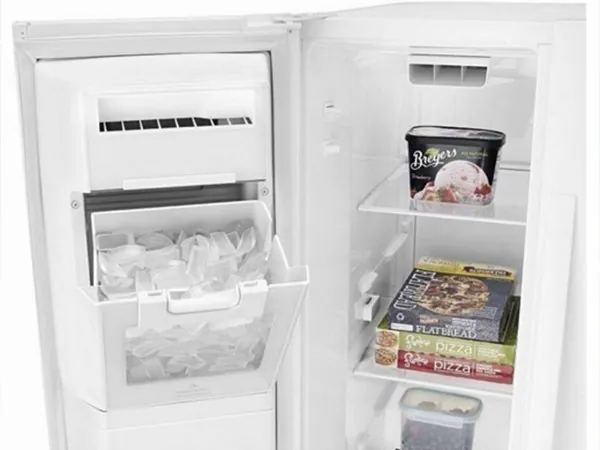
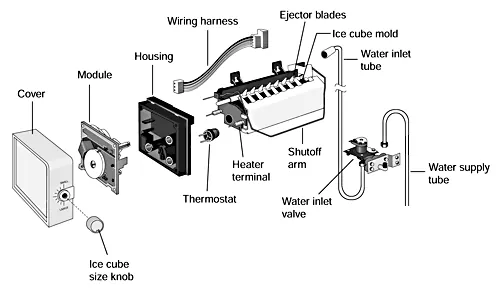
Every cycle depends on five pieces working together; if one part fails, the whole system stops making cubes.
| Part or input | What it does | What you notice when it goes wrong |
|---|---|---|
| Water inlet valve | Opens to fill the mold | No ice forms at all |
| Ice mold | Holds water while freezing | Cubes stick or leak out |
| Mold thermostat | Senses when water is frozen | Ejector runs too early |
| Ejector blades | Push frozen cubes out | Bin stays empty |
| Shutoff arm or sensor | Stops cycle when bin fills | Ice overflows the bin |
Check your refrigerator’s user manual for the exact layout of your model. Manufacturers place these parts differently depending on whether the unit sits in the door or the freezer compartment.
How a fridge ice maker runs one cycle
The whole process takes between 90 and 120 minutes per batch. That range assumes a freezer set to 0°F (-18°C). If yours runs warmer, each step stretches longer.
- The control module signals the water inlet valve to open for about 7 seconds. This assumes standard household water pressure between 20 and 120 psi. Lower pressure means a longer fill time.
- Water flows through a small tube into the plastic or metal ice mold. Gravity spreads it evenly across each cube slot without any pump.
- The freezer’s cold air chills the water until the mold thermostat reads roughly 15°F (-9°C). At 0°F, this usually takes 60 to 90 minutes.
- A small heater under the mold warms up for a few seconds. This loosens the cubes so they don’t crack when pushed out.
- The motor turns the ejector blades one full rotation. They sweep the loose cubes up and out of the mold slots.
- Cubes slide down a short chute into the storage bin below. You’ll hear them clatter against the plastic or wire container.
- The shutoff arm rises as the bin fills. Once it reaches the top position, the control module pauses the whole cycle.
- When you scoop ice out, the arm drops back down. The control module starts the next fill immediately.
Why your fridge ice maker stops working
A symptom points at one specific part, not the whole machine. Empty bins with a humming sound mean the motor tries to turn but the mold is dry. That usually traces back to a stuck water inlet valve or a kinked supply line behind the refrigerator.
If you hear nothing at all, the mold thermostat might be broken. It never tells the control module the water froze, so the ejector never gets the signal to move. Replacing a thermostat costs less than replacing the entire assembly, but only if you can reach it safely.
Cubes that form but won’t drop often point to a burned-out mold heater. Without those few seconds of warmth, the ice locks itself to the metal. Forcing the ejector against frozen cubes strips the gears. That mistake turns a cheap heater fix into a full unit replacement.
Opening the sealed housing to test the motor, transformer, or wiring carries real risk. Leave internal electrical checks to a qualified appliance technician.
What you control and what is fixed
Things you can change
- Freezer temperature: keep it at 0°F (-18°C) for the fastest freeze.
- Water filter: replace it as needed based on usage and consult the owner’s manual for guidance to maintain flow rate.
- Supply line: straighten kinks behind the fridge to restore pressure.
- Bin level: remove ice so the shutoff arm moves freely.
- Mold cleaning: wipe mineral buildup off the tray with white vinegar.
Things built into the design
- Fill time: the control board sets the valve duration by factory programming.
- Heater wattage: molded into the base, it can’t be adjusted higher.
- Cycle speed: the freezer’s cooling capacity sets the hard floor.
- Cube size: the mold shape determines dimensions permanently.
Your own cycle length is printed on the batch currently sitting in your bin.
Habits that keep the ice maker running
Set your freezer to 0°F (-18°C) using the dial or digital panel.
Leave a two-inch gap around the shutoff arm. Stacking bags of frozen food against it holds the arm up, tricking the sensor into thinking the bin is already full.
If you go away for more than a week, lift the shutoff arm manually to pause the cycle. Running water through an empty house risks a slow leak pooling under the fridge.
Frequently asked questions
How long does a fridge ice maker take?
One batch takes 90 to 120 minutes at a 0°F (-18°C) freezer setting. Warmer freezers push that closer to three hours. Check your manual for the rated cycle time of your specific model.
Can I run the ice maker without a water line?
No, it needs a pressurized connection to fill the mold automatically. Without plumbing, the valve opens but nothing flows in. Use standard trays instead if your kitchen lacks a supply line.
Is it safe to eat old ice from the bin?
Ice absorbs odors over time. Toss batches older than two weeks, especially if the bin isn’t sealed. Wash the container with warm soapy water before the next cycle runs.
Does the ice maker use a lot of electricity?
It draws very little power beyond what the freezer already uses. The heater and motor run for only seconds each cycle. The ENERGY STAR refrigerator specifications outline typical energy use for certified models.
What happens if the shutoff arm gets stuck?
The machine keeps cycling until ice spills onto the freezer floor. Clear whatever blocks the arm’s path downward. Bent arms need replacement because they won’t trigger the switch correctly anymore.
How do I clean the ice mold?
Unplug the fridge first, then wipe the mold with white vinegar to dissolve minerals. Don’t scrape it with sharp tools, which scratch the coating and make future cubes stick worse. Rinse and dry before plugging back in.
Why did my ice maker stop after a filter change?
Air trapped in the new filter blocks water flow to the valve. Run two gallons of water through the dispenser to purge the bubbles. After that, the mold should fill normally on the next cycle.
Conclusion
Set the temperature right, change the filter as needed, and leave room for the arm to move so the machine can handle the rest.